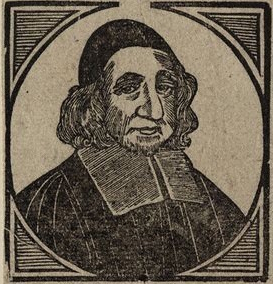
Thomas Brooks
London Puritan whose plain, vivid prose carried Puritan piety into the parishes of the City — and whose writings stayed at Spurgeon's elbow two centuries later.
Thomas Brooks (1608 – 1680)
Brooks was admitted to Emmanuel College, Cambridge — the great Puritan college — in 1625, but the dates of his graduation are not certain. He was preaching by the mid-1640s and served as chaplain in the Parliamentary navy under Admiral Rainsborough during the Civil War. By 1648 he was preacher at St Thomas Apostle's in London, and from around 1652 rector of St Margaret's, New Fish Street, near London Bridge.
He was ejected at the Act of Uniformity in 1662 along with Watson, Manton, and the rest of the London Presbyterians and Independents. He stayed in London through the Great Plague of 1665 — when many ejected ministers returned to deserted City pulpits to minister to the sick — and through the Great Fire of 1666, which destroyed his lodgings. He continued preaching privately, and after the Declaration of Indulgence in 1672 took out a licence as a Congregationalist teacher.
Brooks's books are short, vivid, and aphoristic; they were popular in his lifetime and stayed in print through the eighteenth and nineteenth centuries. C. H. Spurgeon, who held them in high regard, edited a collection of extracts under the title Smooth Stones from Ancient Brooks. He died in London at seventy-two and was buried in Bunhill Fields.
“Remember, it is not hasty reading, but serious meditating upon holy and heavenly truths, that makes them prove sweet and profitable to the soul.”
— Precious Remedies Against Satan's Devices (1652)
Books by Thomas Brooks
Modernised editions, with the original arguments preserved.