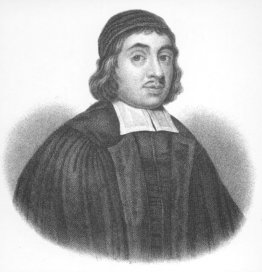
Thomas Watson
Rector of St Stephen's Walbrook, ejected in 1662, and author of the catechetical sermons that became A Body of Practical Divinity — perhaps the most readable Puritan systematic theology.
Thomas Watson (c. 1620 – 1686)
Watson's early life is poorly documented. He matriculated at Emmanuel College, Cambridge — the college that had become the Puritan training-ground in the early seventeenth century — taking his B.A. in 1639 and M.A. in 1642. By 1646 he was rector of St Stephen's, Walbrook, in the City of London, where he served for sixteen years.
In 1651, with several other Presbyterian ministers, he was briefly imprisoned in the Tower for involvement in the abortive Love plot to restore the Stuart monarchy. After the actual Restoration in 1660 he continued at Walbrook until the Act of Uniformity in 1662 ejected him, along with around 2,000 other ministers, for refusing to assent to everything in the Book of Common Prayer. He preached privately during the years of persecution that followed and, after the Declaration of Indulgence in 1672, lectured at Crosby Hall in Bishopsgate alongside Stephen Charnock.
Watson's reputation rests on his sermons rather than systematic treatises. His series on the Westminster Shorter Catechism — published posthumously as A Body of Practical Divinity — is one of the most accessible Puritan expositions of doctrine ever produced. He retired to Barnston, Essex, in failing health, and died there in 1686 while engaged in private prayer.
“The world is a great inn, where we lodge a night or two, and are gone; but heaven is our home.”
— A Body of Practical Divinity
Books by Thomas Watson
Modernised editions, with the original arguments preserved.